From: The White House
Jason Furman, Chairman, Council of Economic Advisers
National Bureau of Economic Research Tax Policy and the Economy Conference
Washington, DC | September 22, 2016
***
From: The White House
Jason Furman, Chairman, Council of Economic Advisers
National Bureau of Economic Research Tax Policy and the Economy Conference
Washington, DC | September 22, 2016
***
From: American Action Forum
President Obama signed executive orders (13,563 and 13,610) as part of an effort to “eliminate red tape.” The president told federal agencies to “modify, streamline, expand, or repeal” existing regulations. The final set of “retrospective reports” from the administration, released recently, reveal that executive agencies have added more than $22 billion in costs, up from $16 billion in the January 2016 update, and $14.7 billion in the July 2015 update. In addition to these net costs from an ostensibly deregulatory exercise, paperwork increased by 17.1 million hours.
From: Notice & Comment | A Blog from the Yale Journal on Regulation and the ABA Section of Administrative Law & Regulatory Practice
by Chris Walker
Yesterday we had three terrific posts on whether Auer deference actually makes a difference in the federal courts of appeals. In other words, do agencies win more when courts apply Auer deference (also known as Seminole Rock deference) to give an agency’s regulatory interpretation “controlling weight unless it is plainly erroneous or inconsistent with the regulation”—as opposed to de novo review or under the less-deferential Skidmore standard.
***
From: American Action Forum
The administration approved 49 regulations last month. Total regulatory costs hit $8.9 billion, with $1.3 billion in annual burdens, and more than 26 million paperwork burden hours. Despite this output, there does not appear to be a surge in regulation thus far.
In our series tracking regulation in the final year of the Obama Administration, this month once again proved the administration is on a record pace to issue significant regulation. Last month, the administration approved 15 significant rules and that figure declined to 12 in August, but it was still more than any comparable period in the past 20 years.
Editor’s Note: For additional insights into Professor Pasachoff’s research, please see here.
From: RegBlog | Penn Program on Regulation
The Office of Information and Regulatory Affairs (OIRA), part of the White House’s Office of Management and Budget (OMB), is often called “the most important government office you’ve never heard of,” for its vast but secretive oversight over agencies’ regulations.
Editor’s Note: Below is the Part 4 of the Wayne Crews’ series of articles on regulatory budgeting. The earlier parts may be found here, here, and here. CRE’s website dedicated the implementation of a regulatory is available here.
From: Competitive Enterprise Institute
This week I began by making the case for a regulatory cost budget but wanted to spend time exploring looming pitfalls and political traps that could derail it or easily make it not worth supporting, or even rendering it something to actively oppose.
Editor’s Note: Gabriel Wedy is a Brazilian Federal Judge, PhD and Master in Law. He is also a Visiting Scholar at Sabin Center for Climate Change Law at Columbia Law School – USA and a Professor of Environmental Law Coordinator at the School of Magistratura- Esmafe / RS. The text below has been translated. Judge Wedy’s original Portuguese text of is available here.
From: Consultor Jurídico
From: Mercatus Center | George Mason University
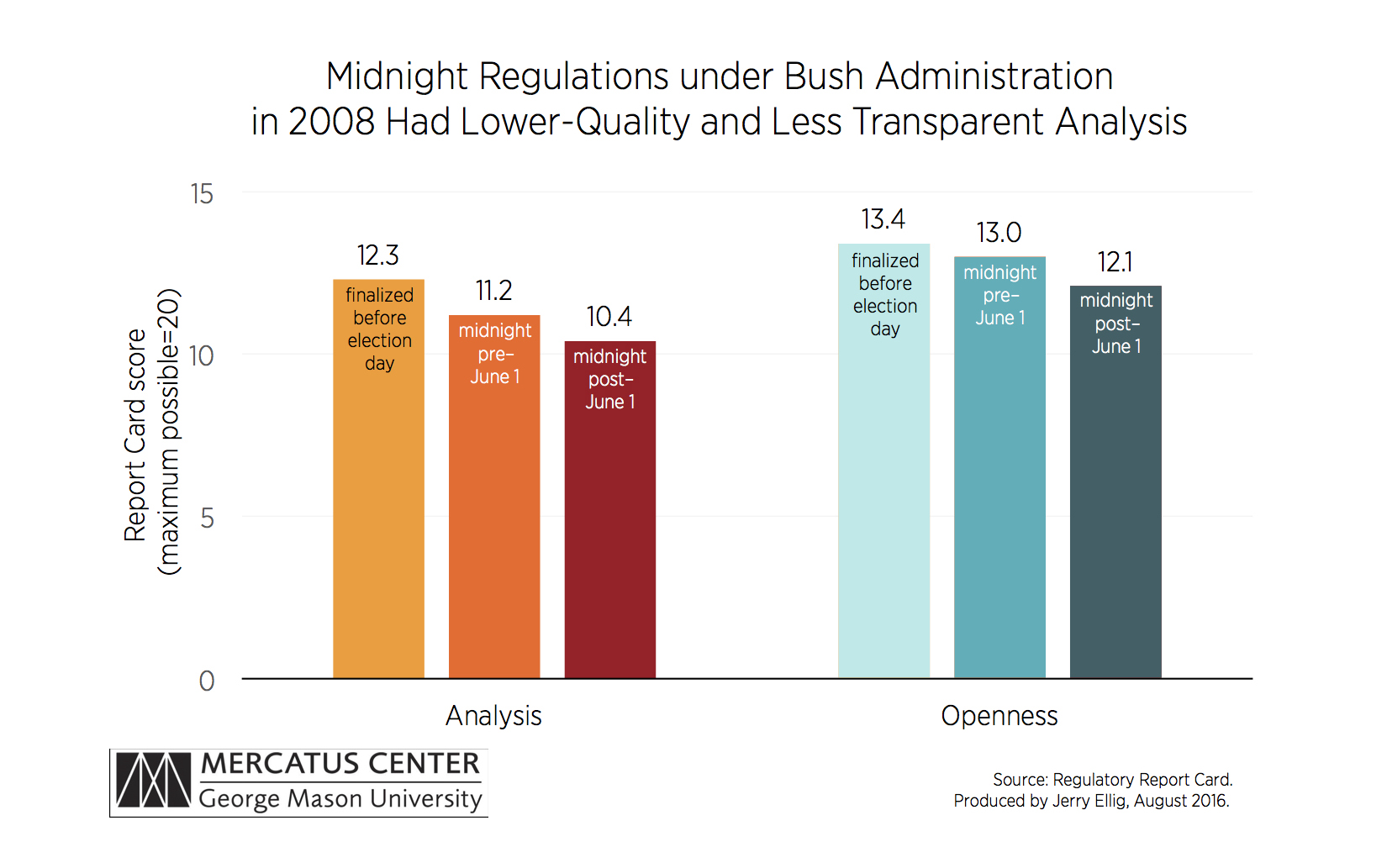
Midnight Regulations Have Lower-Quality and Less Transparent Analysis
The phenomenon known as “midnight regulation”—a surge of regulation that occurs at the end of presidential terms between Election Day and Inauguration Day—is well documented. The Obama administration could issue 50 or more midnight regulations before the president leaves office. One major concern with midnight regulations is that they will be ineffective or excessively costly, because they are not thought through as carefully as other regulations.
Editor’s Note: The Department of Education’s use of evidence is governed by the Data Quality Act and OIRA’s implementing Information Quality Guidelines. Education’s Department-specific guidelines may be found here, OIRA’s “Final Information Quality Bulletin for Peer Review”is available here.
From: Education Week
Note: This week, Deven Carlson, an Assistant Professor of Political Science at Oklahoma University, is guest-blogging. His work explores education policy and politics.
***
Editor’s Note: For a discussion on how medical marijuana could be responsibly regulated, see the Keynote address from the 2014 National Medical Cannabis Unity Conference here.
From: Notice & Comment | A Blog from the Yale Journal on Regulation and the ABA Section of Administrative Law & Regulatory Practice
by Sam Halabi
This week, the Drug Enforcement Agency (DEA) responded to petitions requesting a redesignation of marijuana for the benefit of scientific research. The DEA refused, citing, somewhat tautologically, the fact that there are no scientifically valid and well-controlled clinical trials demonstrating benefits for certain modalities of marijuana for specific medical indications. DEA affirmed marijuana’s continued status as an illicit schedule I controlled substance.