From: Bee Culture
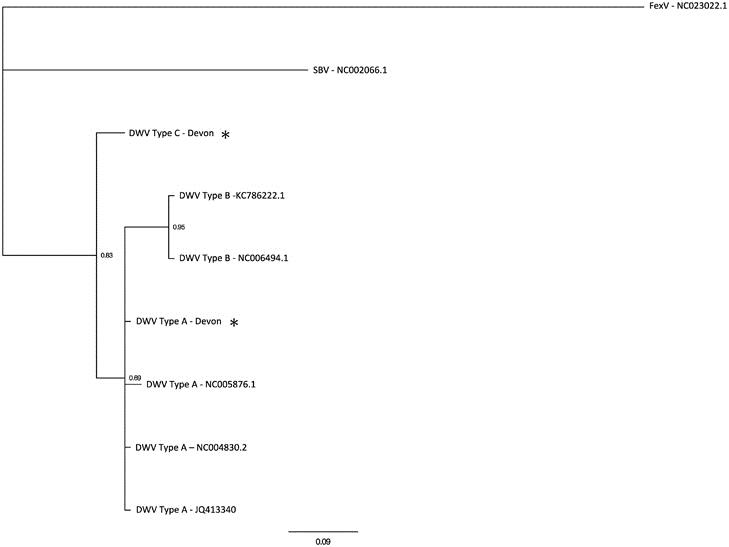
Diversity in a honey bee pathogen: first report of a third master variant of the Deformed Wing Virus quasispecies
Open
Gideon J Mordecai1,2, Lena Wilfert3, Stephen J Martin4, Ian M Jones2 and Declan C Schroeder1
- 1Viral Ecology, Marine Biological Association, Plymouth, UK
- 2School of Biological Sciences, University of Reading, Reading, UK
- 3Centre for Ecology and Conservation, University of Exeter, Penryn Campus, Penryn, UK
- 4School of Environment and Life Sciences, The University of Salford, Manchester, UK
Correspondence: DC Schroeder, Viral Ecology, Marine Biological Association, Citadel Hill, Plymouth PL1 2PB, UK. E-mail: dsch@mba.ac.uk
December 2, 2015
Editor’s Note: Dowload an mp3 podcast of the following story here.
From: Public Radio International (PRI)

Maryann Frazier, a researcher at Penn State’s Center for Pollinator Research, checks on one of her experimental honeybee hives. Frazier says the Varroa mite poses one of the greatest dangers to honeybee populations.
According to bee researcher Maryann Frazier, the Varroa mite, a parasitic mite that feeds on the blood of adult bees and on the brood, is the main thing that’s been wiping out honeybees since the 1990s.
November 30, 2015
From: The Daily Beast
Robert Coolman
With scientists unable to solve the great honeybee die-out, the search for alternate pollinators is on—and killer bees are proving the most resilient, and terrifying, of the bunch.
To understand the wide world of alternative pollinators, the Daily Beast reached out to Michael Burgett, Emeritus Professor of Entomology at Oregon State University.
***
One of the positives of CCD is there’s a lot more money going into bee research. Such attention has led to the discovery of several additional pathogens (including several new viruses) which the varroa mite is hosting. Says Burgett “I would venture to guess that 75 percent of CCD problems are related to varroa and varroa-[related] diseases.”
November 27, 2015
From: WNCT.com CBS 9
By Pierce Legeion
***
”It’s public enemy number one to honeybees in North America.”
Jerry Flanagan, a beekeeper in Pitt County, is talking about the Varroa mite. The parasite is one of the leading causes of colony failure. Infestations have been particularly bad so far this fall.
Read Complete Article
November 25, 2015
From: EverythingLubbock.com
By: Press release from Texas Tech University
In the wake of colony collapse disorder, bee populations have seen dramatic losses in recent years. But a team of Texas Tech University researchers is working on a project to help farmers boost the health of their pollinator pals.
Funded by a $380,579 grant from the U.S. Department of Agriculture’s Natural Resources Conservation Service, the three-year project will study how land not being used for agricultural production can be improved to benefit the diverse and abundant native species that pollinate crops, and then teach producers more effective conservation methods to maintain those populations.
November 23, 2015
From: TheBuzz@OSU | Stories, News and Updates from the World of Pollinators
by Denise Ellsworth
To uncover what plants honey bees rely on, researchers from The Ohio State University are using the latest DNA sequencing technology and a supercomputer. They spent months collecting pollen from beehives and have developed a multi-locus metabarcoding approach to identify which plants, and what proportions of each, are present in pollen samples.
A single colony can collect pollen from dozens of different plant species, and this pollen is useful evidence of the colony’s foraging behavior and nutrition preferences.
Read Complete Article
November 20, 2015
From UNCG Now | University of North Carolina at Greensboro
Story by Jeanie Groh, University Relations
Photography by Martin W. Kane, University Relations

Kaira Wagoner inspects a UNCG beehive.
Kaira Wagoner, UNCG’s Biology Department’s first doctoral student, has uncovered a chemical that could increase the odds of honey bee survival by helping them better combat the parasites within their hives.
***
Wagoner’s research focuses on Varroa destructor, also called the Varroa mite.
Read Complete Article
November 18, 2015
From: Agri-Pulse
By Daniel Enoch
WASHINGTON, Nov. 16, 2015 – U.S. honey bee colonies could be in for a bad winter.
That’s the word from Dick Rogers, the principal scientist with the Bayer Bee Care Center in North Carolina, who’s been studying honey bees for decades. In a blog post, Rogers says he conducts hive evaluations during late summer and early fall, often involving up to 150 samples from hives across the country, and this year he’s alarmed by the prevalence of a hive parasite called the Varroa mite.
November 17, 2015
From: Western Morning News
Campaigners have lost their bid to challenge the lifting of a ban on the use of “bee-harming” pesticides in four English counties.
Environmental group Friends of the Earth (FoE) were refused permission to apply for judicial review of a decision in July allowing farmers to drill oilseed rape seeds coated with two neonicotinoid pesticides this autumn.
A judge ruled their case “unarguable on all grounds”.
Read Complete Article
November 16, 2015
From: CNN
By Vincent Dietemann
[CNN] Editor’s Note: Vincent Dietemann is Extraordinary lecturer in Zoology and Entomology at the University of Pretoria. CNN is showcasing the work of The Conversation, a collaboration between journalists and academics to provide news analysis and commentary. The views expressed in this commentary are solely those of the author.
November 11, 2015
Next page
Previous page
