From: USDA | National Institute of Food and Agriculture
Sonny Ramaswamy, Director, NIFA
Seeing President Obama’s fiscal year 2017 budget proposal and the strong commitment it makes to agricultural research reminds me of Dr. Consuelo De Moraes.
As a university researcher and panel manager of the National Research Initiative (NRI) competitive grants program, I called Dr. De Moraes in 2002 to inform her that USDA was going to fund her research proposal on determining how plants defend themselves against insects, so farmers could exploit the same as a means to control pests. She screamed with happiness. Later I learned that people heard the scream throughout the building at Pennsylvania State University. After that, Dr. De Moraes went on to great acclaim as one of the leading insect researchers.
February 4, 2016
From: Capital Press
Maui County has not been affected by varroa mites, which made their way to Oahu in 2007 and the Big Island in 2008.
WAILUKU, Hawaii (AP) — Maui County beekeepers have been exploring ways to keep bees healthy as the county remains one of the few places untouched by an invasive species known to attack the insects.
***
The Department of Agriculture is trying to find a solution to the pest problem in Hilo. Scientists have been using semen samples to breed a “varroa sensitive hygiene” bee that can better fight off varroa mite. Rusert said “it’s not the silver bullet,” but it will help beekeepers in the area to produce stronger, more resistant hives.
Read Complete Article
February 3, 2016
From: Farming UK
Adult cabbage stem flea beetle damage observations published by AHDB
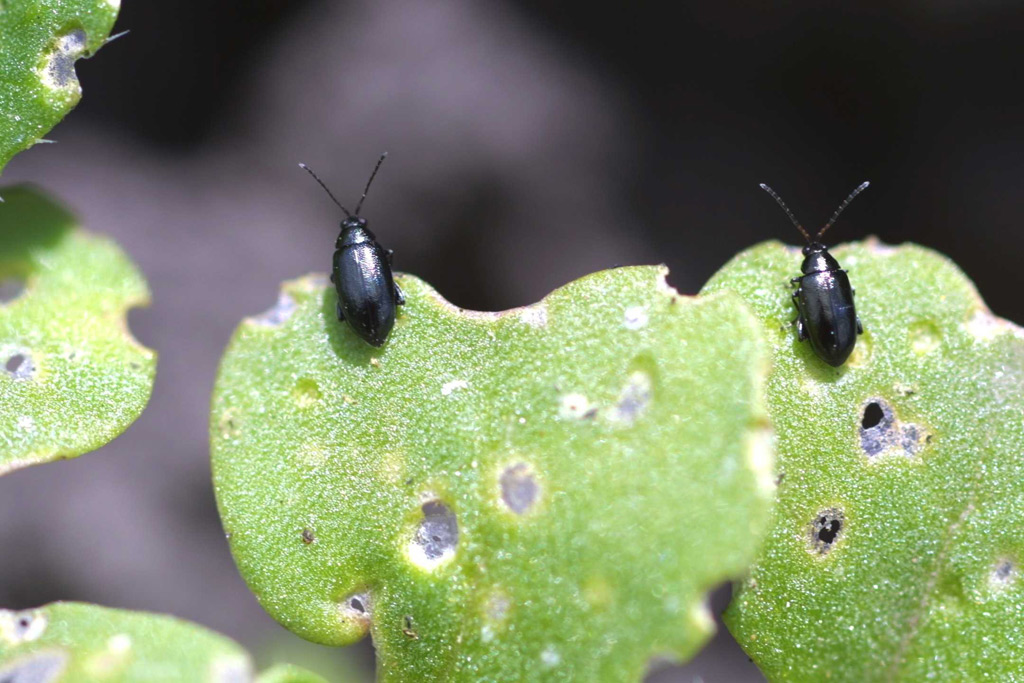
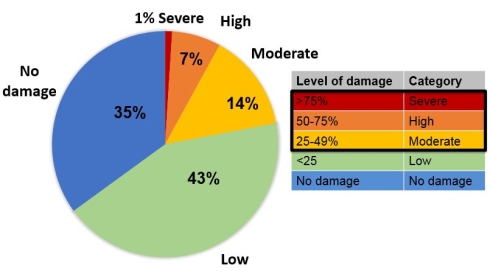
Winter oilseed rape (WOSR) crop losses associated with adult cabbage stem flea beetle activity in autumn 2015 have been estimated at around 1% (6,000ha).
The losses are less than those estimated during autumn 2014, which suggested that 2.7% of the crop area was lost at that time.
However, as different methodology was used, care has to be taken when making direct comparisons.
Read Complete Article
February 2, 2016
From: Ohio’s Country Journal
By Anne Dorrance and Pierce Paul, Ohio State University Extension
Much of Ohio’s soybean production ground is on soils with poor to fair drainage, high clay content, and reduced tillage systems. Any one of these factors alone or in combination contributes to the environmental conditions that favor infection of seeds and seedlings by watermolds. Reduced tillage systems favor pathogen build-up in the very place that the seed is planted each year. Both soybean and corn are attacked by a great diversity of Pythium spp.; some of which are favored by cool, wet soil conditions and others by warmer but also wet soil conditions. Of course for soybean, Phytophthora sojae can be recovered from all of Ohio soils and this is favored by warmer temperatures and wet soils. True fungi, Fusarium spp. and Rhizoctonia solani, are also pathogens of soybean and corn, but for these the amount of inoculum that is present in the field and adequate moisture for pathogen growth is all that is needed to favor infection of both corn and soybean.
February 1, 2016
From: USDA | Agricultural Research Service
By Kim Kaplan
January 26, 2016
The Agricultural Research Service (ARS) is organizing a national bee genebank as part of the agency’s response to ongoing problems facing the country’s beekeepers. Average losses of managed honey bee colonies have increased to more than 30 percent per year due to pathogens, pests, parasites, and other pressures including deficient nutrition and sublethal impacts of pesticides. These stresses have threatened the continued business sustainability of commercial beekeepers.
January 29, 2016
From: Manitoba Co-operator
Industry and government must adjust to new findings, but policies should not
be based on the latest Internet trend
By Cam Dahl
***
Early in January, Canada’s Pest Management Regulatory Agency (PMRA), together with the Environmental Protection Agency in the U.S., released research showing no potential risk to bees as a result of on-label use of these seed treatments. Further, PMRA scientists demonstrated that the treatments generated significant advantages for farmers. The right response to this new evidence would be for the Government of Ontario to reverse course and repeal the regulatory restrictions.
January 28, 2016
Editor’s Note: Health Canada’s Pest Management Regulatory Agency determined that neonicotinoid seed treatments pose ““No potential risk to bees. . . .” It is varroa destructor, not neonics, that is threatening honeybee health, see here.
From: Ontario Ministry of the Environment and Climate Change
Share your thoughts and recommendations on our Pollinator Health Action Plan and help us improve pollinator health in the province.
Your feedback will be considered by the Ministry of Agriculture, Food and Rural Affairs when we report back to the public with a final Action Plan in spring/summer 2016.
Approximate completion time: 15 minutes
January 26, 2016
From: Science Daily
Source: Taylor & Francis
Summary: The parasitic mite Varroa destructor (varroa) is generally agreed to be the greatest threat facing honey bees worldwide. Despite much research, losses continue due to lack of effective control measures, because the mite has become resistant to several commonly used chemicals. The natural product oxalic acid has been widely used in mainland Europe but surprisingly little previous research has directly compared different methods of application, their efficacies, and their adverse effects on bees.
January 25, 2016
From: HoneyBeeSuite | A Better Way to Bee
***
Finding the true culprit
The point of my previous post was that collapse by Varroa is often mistaken for absconding. ButVarroa mites—or more accurately, the diseases they carry—are responsible for a wide array of maladies that are often mistaken for something else. When we don’t see physical evidence of mites—that is, when they are not parading across the bottom board with flags and banners—we tend to blame the something else, whether that something else be absconding, queen failure, starvation, cold, moisture, Nosema, or yellowjackets.
January 21, 2016
Next page
Previous page
