From: PLOS One
David T. Peck, Michael L. Smith, Thomas D. Seeley
Abstract
Varroa destructor, the introduced parasite of European honey bees associated with massive colony deaths, spreads readily through populations of honey bee colonies, both managed colonies living crowded together in apiaries and wild colonies living widely dispersed in natural settings. Mites are hypothesized to spread between most managed colonies via phoretically riding forager bees when they engage in robbing colonies or they drift between hives. However, widely spaced wild colonies show Varroa infestation despite limited opportunities for robbing and little or no drifting of bees between colonies. Both wild and managed colonies may also exchange mites via another mechanism that has received remarkably little attention or study: floral transmission. The present study tested the ability of mites to infest foragers at feeders or flowers. We show that Varroa destructor mites are highly capable of phoretically infesting foraging honey bees, detail the mechanisms and maneuvers by which they do so, and describe mite behaviors post-infestation.
December 14, 2016
From: Genetic Literacy Project
Jon Entine
Jon Entine, GLP director, will be holding a Science “Ask Me Anything” entitled Pesticides, Bees and Pollinator Health on Tuesday, December 13, 2016, between 2 pm and 4 pm ET. Questions can be submitted by visiting the AMA at the Reddit Science page at: https://www.reddit.com/r/science/comments/5i3dfr/science_ama_series_im_jon_entine_executive/
Hi Reddit! I’m Jon Entine, a science journalist and founder of the Genetic Literacy Project and Epigenetics Literacy Project (501c3 as the Science Literacy Project), which cover the intersection of human genetics and agricultural sciences with public policy.
December 13, 2016
From: AgriNews
Mite threatens European species
WEST LAFAYETTE, Ind. — A sister species of the Varroa destructor mite is developing the ability to parasitize European honeybees, threatening pollinators already hard pressed by pesticides, nutritional deficiencies and disease, a Purdue University study said.
***
To bee researchers, it’s a grimly familiar story: V. destructor made the same host leap at least 60 years ago, spreading rapidly to become the most important global health threat to European honeybees.
Read Complete Article
December 12, 2016
From: Forbes
Nancy Kavazanjian and Jay Hill | Nancy, with Hammer and Kavazanjian Farms, is a corn, soybean and wheat farmer. Jay, with Hill Farms, is a vegetable, nut and beef farmer.

This year, we established 16 acres of pollinator habitat on our Wisconsin corn, soybean and wheat farm. . We’ve made this part of our Conservation Stewardship Program, and my husband and I are pretty proud of this.
***
December 9, 2016
Editor’s Note: Translation from the French original via Google Translate.
From: Le Huffington Post
Against the decline of bees in France, the researchers may have found a way out
Annabel Benhaiem, Journaliste, Le Huffington Post

Parmi les causes du déclin des abeilles noires en Europe, on trouve le parasite Varroa, qui ressemble à un petit pou rond. [Blaine Franger]
ENVIRONMENT – Will bees win against mites? This long-term battle is on the way to finding a way out, revealed Thursday December 8 at the Anses International Scientific Meeting on Bee Health.
December 8, 2016
From: Genetic Literacy Project
Jon Entine
Scientists are now in agreement that we are not facing a beepocalypse as many in the media have been maintaining. Bee populations aren’t declining; they’re rising. According to statistics kept by the U.S. Department of Agriculture and the Food and Agriculture Organization of the United Nations, honeybee populations in the United States, Canada and Europe have been stable or growing for the two decades
December 7, 2016
From: USDA Ag Research Magazine
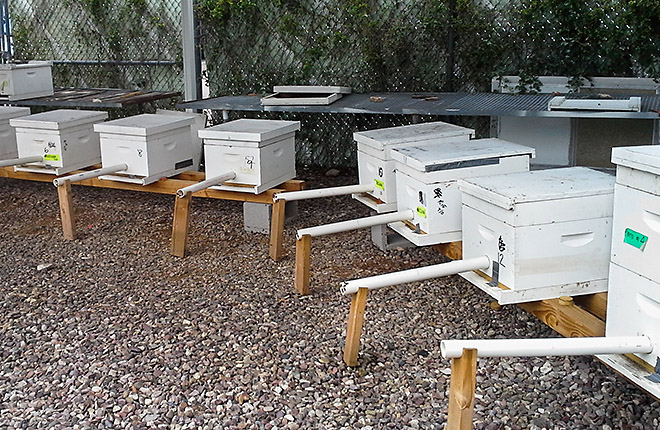
***
The Varroa mite, Varroa destructor, is considered public enemy number one to honey bees nationwide. The parasite feeds on the blood of adult bees and their brood, weakening them and endangering the entire hive when infestations become severe. But the mite also poses an indirect threat to more than 90 flowering crops that depend on bee pollination, including almonds, apples, blueberries, cherries, and cantaloupes.
***
The researchers’ investigations in North Dakota this summer will follow up on their leading theory to explain this phenomenon, dubbed “mite migration.” It holds that Varroa mites move among colonies by attaching to forager bees.
December 5, 2016
Editor’s Note: The Australian government performed a comprehensive review of neonicotinoids, for more information about government evaluations of neonics, see here.
From: New Zealand EPA via Scoop.co.nz
EPA keeps watching brief on Canada’s neonicotinoid decision
The EPA is keeping a watching brief on international developments following Health Canada’s proposed re-evaluation decision of agricultural use of the neonicotinoid imidacloprid, which it states is unsustainable.
The announcement, on November 24, came at the same time as Health Canada announced a Special Review of two other neonicotinoids: clothianidin and thiamethoxam.
December 2, 2016
Editor’s Note: The English below is via Google Translation.
From:  Salamanca
The fight against varroa, the main battlefield for beekeeping in Salamanca

Beekeepers denounce and acknowledge that varroa is already the main concern for beekeeping, which also causes other diseases.
The varroa has already become ‘official’ in the main concern of beekeepers, whose death rate of hives soars and their control and struggle is one of the main challenges for professionals in the province of Salamanca and all Castilla y León.
December 1, 2016
Next page
Previous page
