From: Growing Produce
Posted By: Carol Miller
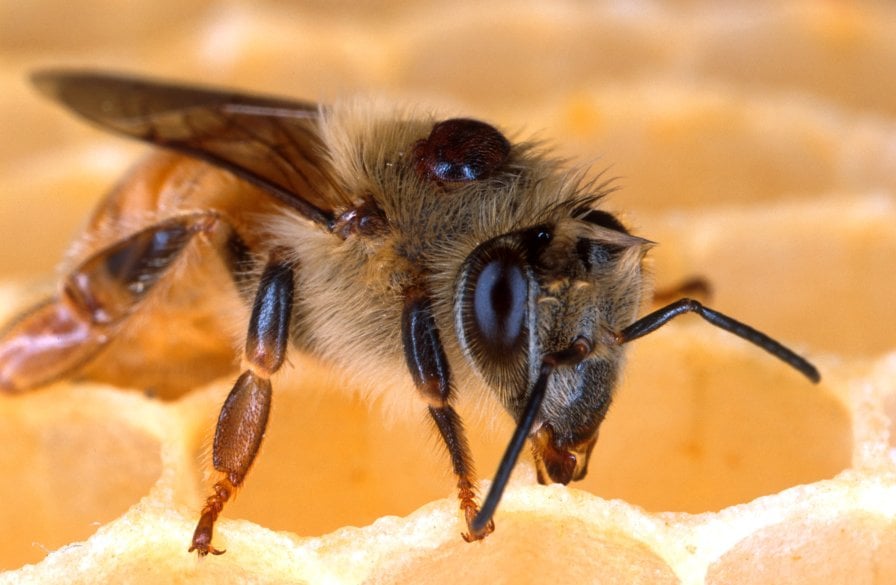 Varroa mites, like the one attached to the back of this honey bee, can decimate unprotected hives. The tiny parasites feed on the bees’ blood and can infect them with harmful viruses. (Photo credit: Scott Bauer, USDA-ARS)
Cornell University’s NYS Beekeeper Tech Team released a report showing that the state of the New York’s beekeepers are being overwhelmed by varroa mites in 2016. A full 90% of colonies sampled had the parasitic pests.
***
August 4, 2017
From: Newsweek
By Janice Williams
***
But newly released figures from the USDA indicate a break in that trend. Only about 84 colonies were lost in first quarter of 2017. That figure is 27 percent less than the number of colonies reported lost for the first quarter of 2016.
But the news isn’t completely rosy. Varrora mites, a parasite that lives inside beehives, are one of the many causes that researchers believe could be behind the losses. And the new report lists these mites as the top stressor responsible for lost colonies. The parasites, which survive by sucking insect blood, were reported in 42 percent of commercial bee hives. However, the department noted that instances of the varrora mites, which first started plaguing bee hives in 1987, were still down some 11 percent compared to the 53 percent of hives affected by the parasites the year before.
August 3, 2017
From: Bloomberg
By Alan Bjerga
The number of U.S. honeybees, a critical component to agricultural production, rose in 2017 from a year earlier, and deaths of the insects attributed to a mysterious malady that’s affected hives in North America and Europe declined, according a U.S. Department of Agriculture honeybee health survey released Tuesday.
***
August 2, 2017
From: BNA Daily Environment Report
Bee Pesticide Ban Debate Could Arise in Next Farm Bill
By Tiffany Stecker
***
Thirty-one Democrats are backing a bill—the Saving America’s Pollinators Act of 2017 ( H.R. 3040)—that would suspend the approval of neonicotinoid pesticides, common insect-killers that are said to harm honeybees, aquatic insects, birds, and other insects and animals. H.R. 3040 would ban imidacloprid, clothianidin, thiamethoxam, dinotefuran, and any other neonicotinoids until the Environmental Protection Agency can determine that the pesticides won’t harm pollinators, based on peer-reviewed studies.
***
August 1, 2017
From: FarmingUK
An NFU scientist has complained of a “conspiracy of silence” following the publication of a pan-European study on the impact of neonicotinioids on bees.
Dr Chris Hartfield, the NFU’s acting chief science and regulatory affairs adviser, says that whilst most press and media coverage has suggested the study shows a link between use of neonicotinoids and falling bee numbers, most of the study’s results showed no impact whatsoever and some results recorded a positive effect.
“There are only six out of 84 results that show a negative impact,” he told FarmingUK.
Read Complete Article
July 31, 2017
From: New Mexico State University
‘Bee’ healthy: NMSU researchers study medicinal benefits of oregano for bees
Writer: Jane Moorman
***
Bees preserved in saline solution are being sent to the Bee Information Partnership, a nation-wide beehive health database.
“We are adding our findings to that database to have records of these exact hives as they progress,” Heyduck said. “Population samples of Varroa mite, a parasite threatening honeybees worldwide, will be taken at multiple times from the project hives and will serve as an indicator of oregano’s effect on bee health.”
Read Complete Article
July 28, 2017
From: Manuka Honey USA
***
The Effect of Varroa Mites
One person who agrees that varroa mites are a huge problem is Emma Mullen, who leads the beekeeper tech team at Cornell University, which is funding numerous research teams searching for answers about the high die-off rates. “The varroa mite is a parasite that’s kind of similar to a tick, and it actually latches onto honeybees and it sucks the blood and feeds on the fat stores of honeybees,” Mullen says. “We’re actually working with [other local] beekeepers to figure out what solutions we can come up with.”
July 27, 2017
From: Daily Nation
By VERAH OKEYO
***
The centre’s African Reference Laboratory for Bee Health headquartered in Nairobi carried out studies that proved the resilience of the African bee against varroa mites, the insects that are implicated in colony collapse in Europe and the Americas.
Dr. Michael Lattorff, Icipe’s head of Environmental Health termed the mite as the most detrimental to bees because it sucks blood of bees in the larva stage and infects them with viral diseases such as the deformed wing virus.
Read Complete Article
July 26, 2017
The distinguished authors of The Complex Life of the Honey Bee: Environmental, Biological, and Chemical Challenges to Colony Health discuss the crucial role of the Data Quality Act in ecological risk assessments. Below is an excerpt. The complete Purdue Extension publication is available here.
July 25, 2017
Next page
Previous page

