From: BeeInformed.org
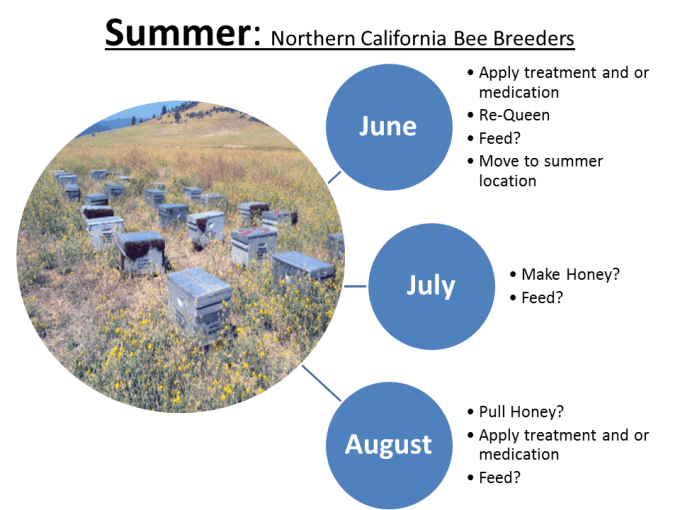
The graphic above illustrates the basic cycle of beekeeping during the summer season in northern California
The graphic above illustrates the basic cycle of beekeeping during the summer season in northern California. Things like applying treatments and feeding are management decisions based on what the bees are doing in response to the environment around them. Feeding and treating is operation specific and location dependent.
October 9, 2012
From: Symmetry – Dimensions of Particle Physics
About 30 percent of bees in the United States die of disease, infection or other causes each year, a number beekeepers say will have a serious impact on agriculture. Could particle accelerators be the solution?
Inside their hives, bees face a variety of enemies. Parasites transfer diseases. Bacteria infect honey. Fungi overwhelm larvae. These problems can become so rife that the hives are rendered inhospitable.
To save their bee colonies, some beekeepers turn to particle accelerators.
October 8, 2012
Editor’s Note: The interview with James Marshall of the University of Sheffield is available (mp3 format) here.
From: 89.3 KPCC Southern California’s Public Radio
Colony Collapse Disorder is how scientists describe the mysterious die off of honey bees around the globe. Honey bees pollinate lots of different types of crops and researchers are concerned that food supplies could be affected by the disorder. The cause of colony collapse is still unknown but scientists in England are working on a project that could mitigate its effects.
October 5, 2012
From: SwissInfo.ch
by Olivier Pauchard
Swiss beekeepers are hoping for a cold autumn and spring after last year’s mild temperatures turned honeycombs into honeyed tombs – mostly because of the Varroa mite, which feeds on healthy bees.
October 3, 2012
From: Teaching Biology
Bowing down to popular opinion again, I’ve changed this so that only interesting papers are put in. People complained about there being too many frivolous papers that aren’t of general interest outside of a narrow field of specialists. So from now on, I’m attempting to include only papers that aren’t specific case studies and that may be of public or interdisciplinary interest. Please understand that I have a lot of trouble relating to what other people find interesting though, so YMMV! If you prefer the old-style, let me know so I can tally up votes.
October 1, 2012
In evaluating the petition EPA must ensure that all data and reports to support the petition that EPA considers and relies on comply with the Data Quality Act (DQA). Moreover, section II of this comment outlines studies used by the petitioners that are clearly not compliant with the DQA and therefore EPA shall not consider the studies in evaluating the petition.
Finally, a substantial number of recent scientific studies conclude that Varroa Mites are the major cause of bee health decline, not clothianidin. Consequently there is no basis for suspending the registration of clothianidin.
September 29, 2012
From: ScienceCodex.com
The parasitic mite Varroa destructor is a major contributor to the recent mysterious death of honey bee (Apis mellifera) colonies. New research published in BioMed Central’s open access journal Genome Biology finds that specific proteins, released by damaged larvae and in the antennae of adult honey bees, can drive hygienic behavior of the adults and promote the removal of infected larvae from the hive.
September 28, 2012
From: Digital Journal
By Leigh Goessl
It has been confirmed an amateur beekeeper in Washington state has found “zombie bees” on his property. This is the first time “zombees” have been identified in Washington state.
At first the man didn’t realize the bees were infected by the condition caused by parasitic flies, however, he collected some samples and has been tracking to see what happens. So far, he is seeing classic signs of the strange phenomenon.
September 25, 2012
From: The Telegraph (Georgia)
By CHRISTINA M. WRIGHT
Bees are, well, the bee’s knees.
“Nine times out of 10, you’re wearing a cotton shirt,” said Bear Kelley, president of the Heart of Georgia Beekeepers. “You can thank the bees for that. Because they pollinated the cotton. Thirty percent of what we as humans consume is pollinated by bees.”
Perry Mayor Jimmy Faircloth said that’s why City Council is considering an ordinance to allow — but regulate — urban beekeeping. Beekeepers have spent recent months explaining the importance of honeybees, the precarious state of the honeybee population and why a growing number of people want hives in their yards.
September 24, 2012
Editor’s Note: Sloppy science is not going to make it in the review of bee health decline. US regulatory agencies must meet the requirements of the Data Quality Act; even in the absence of the Act, responsible scientists in Europe are rejecting biased, off the cuff studies as noted in the article below. The EPA SAP and the Department of Agriculture in their upcoming reviews will benefit from these analyses.
CRE has under consideration a project to perform a detailed review of the British and French studies. Any of our readers who have views on this matter please contact us here.
September 21, 2012
Next page
Previous page